

基于MATLAB的多目标人脸检测和识别技术研究
基于MATLAB的多目标人脸检测和识别技术研究(任务书,开题报告,外文翻译,论文19000字)
摘要
在信息技术不断发展的今天,人脸检测和识别技术因其综合了物理学,生物学,神经网络等多个领域的知识而成为计算机视觉领域一个极为重要的研究对象。时至今日人脸检测和识别已经被广泛关注,基于人脸检测和识别的应用也层出不穷。但在其高速发展的同时,因噪声,光照等一系列原因引发的人脸检测识别性能不佳的问题也亟待解决。
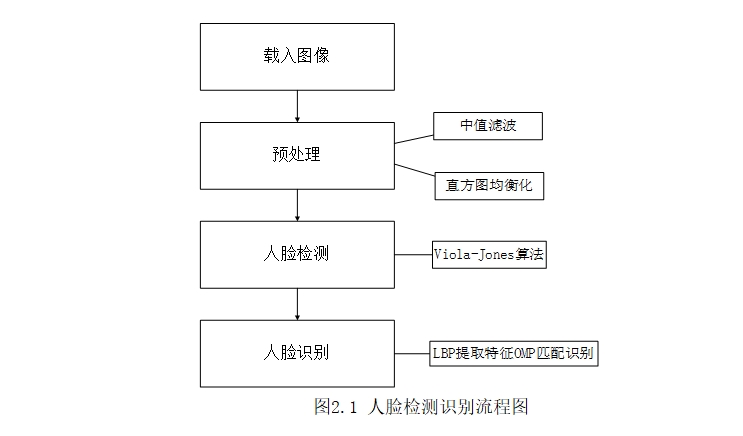
基于对含多人脸的图像或视频进行检测和识别已经被广泛应用于小区或公司监控等安防领域的现状,本文基于MATLAB平台研究设计了一个针对静态图片的多目标人脸检测和识别的解决方案。在预处理部分采用中值滤波去噪和直方图均衡化减弱光照影响,在人脸检测部分采用了高效准确的Viola-Jones算法,分割检测到的人脸后,逐一利用LBP提取特征纹理信息然后用改进的正交匹配追踪算法进行特征匹配识别。主要改进有以下两点:
1) LBP提取特征值时,将传统的循环数据比对运算改为了MATLAB更擅长的矩阵运算,将人脸图像拆分成多个小区域矩阵然后与中心区域矩阵进行比对。
2) 针对人脸识别对传统的OMP算法进行了改进,即新增一个迭代收敛条件使其在保证准确率的同时提高运算效率。
最终还通过MATLAB设计了GUI界面从而更加方便的进行人脸检测识别以及训练测试其准确率和识别时间。测试结果显示其在有效的降低了噪声,光照等对检测识别的影响的同时识别速度也保证在0.5s以内,并且准确率在经过基于ORL人脸库的训练后可达到95%。
关键词:人脸检测;人脸识别;正交匹配追踪
Abstract
With the continuous development of information technology, face detection and recognition technology has become a very important research object in the field of computer vision because of its comprehensive knowledge of many fields, such as physics, biology, neural network and many other fields. Nowadays, face detection and recognition have been widely concerned, and applications based on face detection and recognition are endless. However, at the same time of its rapid development, the problem of poor performance of face detection and recognition caused by a series of reasons such as noise, illumination and so on is also urgently needed to solve.
The detection and recognition of images or video based on multiple faces has been widely used in the security areas such as community or company monitoring. Based on the MATLAB platform, a solution for multi-objective face detection and recognition for static images is designed and designed. In the process of preprocessing, median filter de-noising and histogram equalization are used to weaken the influence of illumination. The face detection section uses an efficient and accurate Viola-Jones algorithm. After segmentation detection of face, the feature texture information is extracted by LBP, and the improved orthogonal matching tracking algorithm is used to identify the feature matching. The main improvements are the following two points: [来源:http://www.doc163.com]
1) LBP extracts the eigenvalues, the traditional cyclic data comparison operation is changed to the matrix operation that MATLAB is better at, and the face image is split into multiple cell domain matrices and then compared with the center area matrix.
2)For face recognition, the traditional OMP algorithm is improved, that is, an iterative convergence condition is added to ensure the accuracy while improving efficiency.
Finally, the GUI interface is designed through MATLAB, which makes it more convenient for face recognition and training to test its accuracy and recognition time. The test results show that it can reduce the noise effectively, and the speed of recognition is gu4aranteed to be within 0.5s at the same time, and the accuracy rate can reach 95% after the training based on the ORL face database.
Keywords: face detection; face recognition; orthogonal matching pursuit.
[来源:http://www.doc163.com]
目录
第1章 绪论 1
1.1 数字图像处理介绍 1
1.2 人脸检测识别的发展现状分析 1
1.3 本次课题的研究目的及意义 2
1.3.1 研究目的 2
1.3.2 研究意义 2
1.4 本次毕设内容安排 3
第2章 目标和总体设计 4
2.1 本次毕设目标 4
2.2 总体设计 4
2.3 本章小结 5 [资料来源:http://doc163.com]
第3章 预处理 6
3.1 中值滤波 6
3.1.1 中值滤波基本原理 6
3.1.2 中值滤波优点 7
3.2 直方图均衡化 7
3.2.1 直方图均衡化基本原理 7
3.2.2 直方图均衡化优点 8
3.3 本章小结 8
第4章 人脸检测 9
4.1Viola-Jones的整体框架 9
4.2第一部分 9
4.2.1haar-like特征 9
4.2.2积分图 10
4.3 第二部分 11
4.3.1 Adaboost算法介绍 11
4.3.2 Adaboost在Viola-Jones的应用 11
4.4第三部分 12
4.5 本章小结 13
第5章 人脸识别 14
5.1 LBP提取特征信息 14
5.1.1 LBP介绍 14
5.1.2 LBP提取特征信息 15 [来源:http://Doc163.com]
5.1.3LBP算法的优点 16
5.2 OMP算法进行特征匹配 17
5.2.1稀疏表示 17
5.2.2正交匹配追踪算法(OMP)基本原理 18
5.2.3传统正交匹配追踪算法具体步骤 19
5.2.4 传统OMP用于人脸识别的弊端 21
5.2.5 针对人脸识别对OMP进行的改进 21
5.2.6 改进OMP算法MATLAB的实现 22
5.3本章小结 23
第6章 系统界面设计 24
6.1界面整体框架 24
6.2训练模块 25
6.2.1训练模块实现的功能 25
6.2.2 关键代码解释 26
6.3测试模块 27
6.3.1测试模块实现的功能 27
6.3.2关键代码解释 29
6.4 成果展示 30
6.5 本章小结 33
第7章 总结和展望 34
7.1工作总结 34
7.2工作展望 34
参考文献 35
致谢 37 [资料来源:http://Doc163.com]